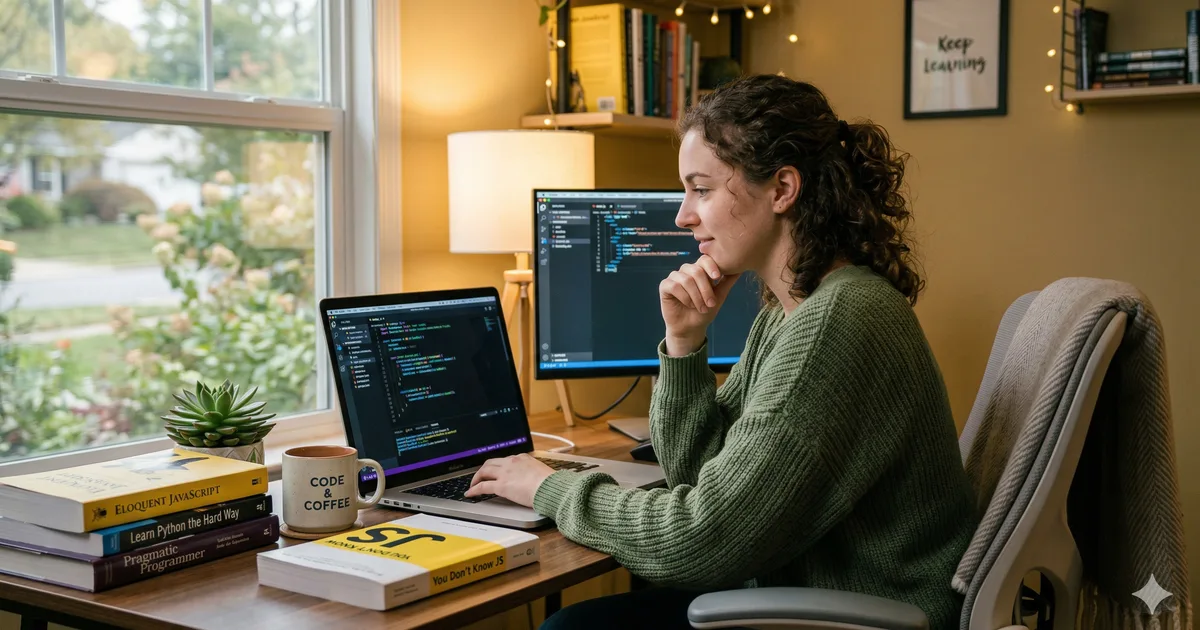

Why learn to program in 2026
Programming is no longer a skill exclusive to systems engineers. In 2026, knowing how to code is a competitive advantage in almost any profession: marketing, finance, medicine, law. And for those who want to pursue software development professionally, opportunities in Latin America have never been better.
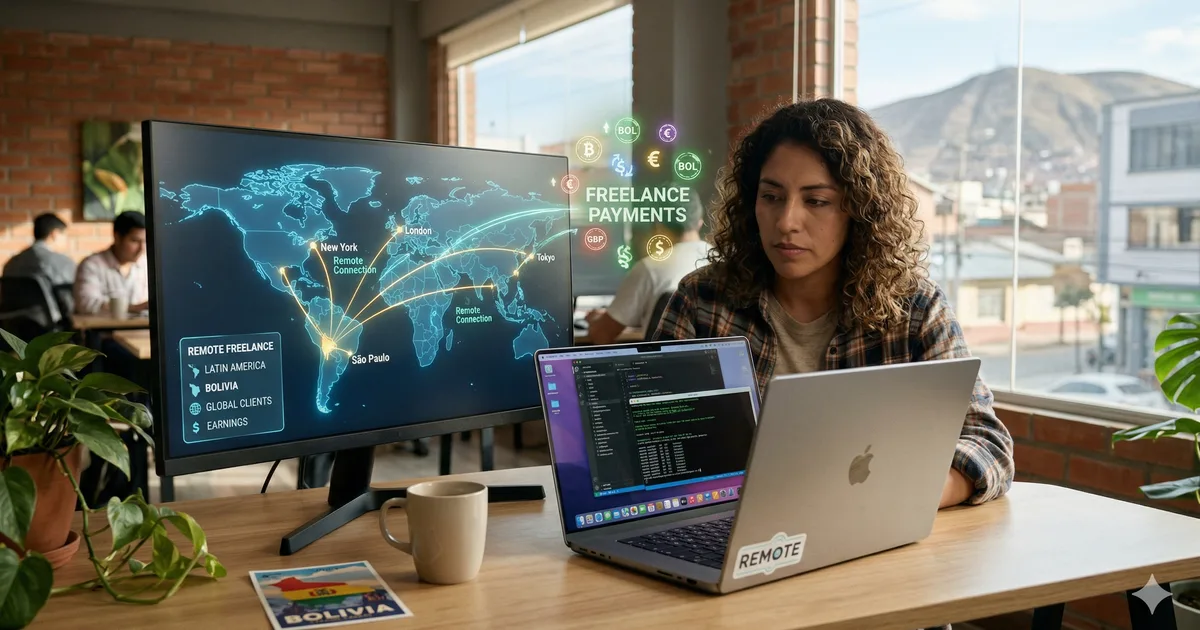
In Bolivia, where we founded Bemorex, we have seen self-taught developers go from earning local salaries to working remotely for Silicon Valley companies. The path is not easy, but it is real and accessible.
The right mindset before starting
Programming is problem-solving
The biggest mistake beginners make is thinking that programming is about memorizing syntax. It is not. Programming is about breaking down complex problems into simple steps and translating them into instructions a machine can execute.
Consistency beats talent
I have seen people with master's degrees in computer science who never finish a project, and self-taught developers without a college degree who build incredible products. The difference is consistency: 1 hour daily for 6 months is worth more than 8 hours on a weekend every 3 weeks.
The path is not linear
There will be days when everything works and you feel like a genius. There will be others where a bug keeps you stuck for 4 hours without progress. Both are normal. The important thing is not to give up on the difficult days.
Choosing your first language
This is the most common question, and the answer is simpler than it seems:
JavaScript: the most versatile option
JavaScript is the only language that runs in the browser, on the server (Node.js), in mobile apps (React Native), and even in IoT. If you do not know where to start, start here.
Advantages:
- You can see immediate results in the browser
- The Spanish-speaking community is enormous
- You can do frontend, backend, and mobile with a single language
- Largest number of job offers in LATAM
Python: the most beginner-friendly option
Python has a clean and readable syntax that makes it ideal for beginners. It is the dominant language in data, AI, and automation.
Advantages:
- Clear syntax close to natural language
- Dominates the data science and AI field
- Excellent for automation and scripting
- Large number of educational resources in Spanish
Which one to choose?
- If you are interested in web development: JavaScript
- If you are interested in data, AI, or automation: Python
- If you do not know what interests you: JavaScript (more versatile for exploring)
6-month roadmap for beginners
Month 1-2: Programming fundamentals
Do not touch any framework yet. Focus on:
- Variables and data types: Numbers, strings, booleans, arrays, objects
- Control structures: if/else, switch, for and while loops
- Functions: Declaration, parameters, return values
- Basic logic: Operators, comparisons, boolean logic
Free resources in Spanish:
- freeCodeCamp in Spanish
- MDN Web Docs (has Spanish translation)
- YouTube channels like Midudev, Fazt, HolaMundo
Month 2-3: HTML and CSS (if you chose JavaScript)
Before diving deep into JavaScript, you need to understand the structure of the web:
- HTML: Semantics, forms, basic accessibility
- CSS: Box model, flexbox, grid, responsive design
- Project: Recreate 3 existing web pages (do not copy the code, only the design)
Month 3-4: JavaScript/Python in depth
Now yes, go deeper into your chosen language:
- JavaScript: DOM, events, fetch API, promises, async/await, ES6+
- Python: Modules, file handling, pip, virtual environments, requests
Mandatory project: Build something that consumes a public API. Ideas:
- Weather app with OpenWeather API
- Movie search with OMDB API
- Translator with LibreTranslate API
Month 4-5: Professional tools
- Git and GitHub: Commits, branches, pull requests, collaboration
- Terminal: Basic navigation and file management commands
- Code editor: VS Code with essential extensions
- Debugger: Learn to use the browser DevTools
Month 5-6: Your first framework
With a solid foundation, now you can learn a framework:
- Frontend: Angular, React, or Vue (pick one and go deep)
- Backend: Express (Node.js) or Django (Python)
- Database: Learn at least one (PostgreSQL, MongoDB, or Firebase)
Free vs paid resources
Quality free resources
You do not need to spend money to learn programming. These resources are completely free:
- freeCodeCamp: Complete curriculum with certifications
- The Odin Project: Focused on full-stack web development
- CS50 from Harvard: The best introductory computer science course
- MDN Web Docs: The definitive reference for web development
- Official documentation: Angular, React, Vue, Python all have tutorials
When it makes sense to pay
Invest money only after exhausting free resources and if you need:
- Structure and accountability: Bootcamps that give you a plan and deadlines
- Mentorship: Access to a professional who reviews your code
- Specific certifications: AWS, Google Cloud, Azure
Bootcamps: are they worth it?
In Latin America there are bootcamps from $500 to $5000 USD. My honest opinion:
- They are worth it if: You need structure, you cannot learn on your own, the bootcamp has a good employability rate
- They are not worth it if: You are already disciplined, you can follow a roadmap on your own, the bootcamp has no real employment data
Mistakes that slow your progress
Tutorial hell
The number one mistake. You watch tutorial after tutorial but never build anything of your own. The solution: for every tutorial you watch, build a personal project applying what you learned.
Constantly switching technologies
You start with JavaScript, 2 weeks later you switch to Python, then Rust, then Go. This is procrastination disguised as learning. Choose a path and stick with it for at least 6 months.
Studying without practicing
Reading documentation and watching videos is not enough. You learn programming by programming. The ideal ratio is 20% theory, 80% practice.
Not asking for help
If you have been stuck on a problem for more than 2 hours, ask for help. Use Stack Overflow, Discord, or ask a colleague. There is no reward for suffering in silence.
Comparing yourself to others
Seeing that someone learned React in 2 weeks can be demoralizing. But you do not know their context: maybe they already knew another framework, maybe they have 10 free hours a day. Compare your progress only with yourself.
Community is your superpower
In Latin America, the tech community is incredibly welcoming. Connecting with others who are learning has enormous benefits:
- Motivation: Seeing others progress pushes you forward
- Networking: Job opportunities come through connections
- Learning: Explaining what you know to others reinforces your knowledge
- Support: When you get frustrated, someone understands you
Look for communities on Discord, Telegram, and local meetups. If there are no meetups in your city, create one. In Oruro we started with 5 people and now we are an active community.
AI tools as allies
In 2026, AI tools like GitHub Copilot, Claude, and ChatGPT are part of a developer's daily life. But using them as a beginner requires caution:
Use them for:
- Understanding errors you cannot solve
- Learning code patterns by reading suggestions
- Generating boilerplate you already understand
Do not use them for:
- Copying code without understanding it
- Solving practice exercises (you lose the learning)
- Replacing the process of thinking and debugging
AI is a tool, not a shortcut. A junior who completely depends on AI is a junior who does not grow.
Your action plan starting today
- Today: Install VS Code and create a GitHub account
- This week: Choose your language and start with the fundamentals
- This month: Complete your first mini-project
- In 3 months: Have 2 working projects on your GitHub
- In 6 months: Start applying for your first job
Conclusion
Learning to program is one of the best investments you can make in 2026, especially in Latin America where the demand for developers far exceeds the supply. You do not need a college degree, you do not need to spend thousands of dollars, and you do not need to be a math genius.
What you need is consistency, a clear plan, and the willingness to not give up when things get difficult. And they will get difficult. But on the other side of that difficulty is a career with good income, geographic flexibility, and the satisfaction of creating things that people use.
Start today. Your future self will thank you.

Comments (0)
Sign in to comment