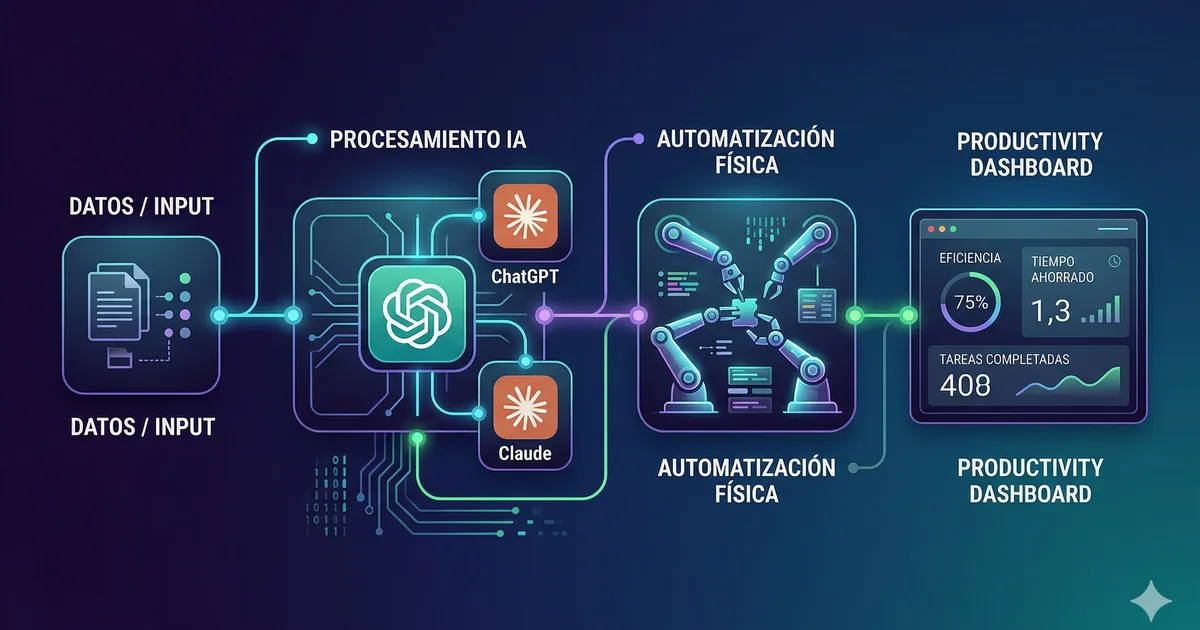

Why automate with AI?
As developers, a significant part of our day goes to repetitive tasks: writing commits, reviewing PRs, documenting code, updating changelogs. AI can handle these tasks, freeing you for the creative work that truly matters.
These are 10 proven workflows you can implement today.
Workflow 1: Intelligent commit messages
Instead of writing commit messages by hand, let AI analyze your diff and generate messages following Conventional Commits.
How it works
The prepare-commit-msg hook runs automatically before each commit. It reads the diff of staged files, sends it to the Claude API, and writes the suggested message.
Setup
- Copy the script to the
.git/hooks/directory - Make it executable:
chmod +x .git/hooks/prepare-commit-msg - Configure your API key as an environment variable
Workflow 2: Automatic function documentation
Every time you save a file, a script generates or updates TSDoc documentation:
import { readFileSync, writeFileSync } from 'fs';

interface DocResult {
  content: Array<{ text: string }>;
}

async function generateDocs(filePath: string): Promise<string> {
  const code = readFileSync(filePath, 'utf-8');

  const response = await fetch('https://api.anthropic.com/v1/messages', {
    method: 'POST',
    headers: {
      'Content-Type': 'application/json',
      'x-api-key': process.env.ANTHROPIC_API_KEY ?? '',
      'anthropic-versión': '2023-06-01'
    },
    body: JSON.stringify({
      model: 'claude-haiku-3-5-20241022',
      max_tokens: 2048,
      system: 'Agrega TSDoc a todas las funciones y clases que no lo tengan. Devuelve SOLO el código completo con la documentación agregada. No cambies ninguna lógica.',
      messages: [{ role: 'user', content: code }]
    })
  });

  const data: DocResult = await response.json();
  return data.content[0].text;
}
Workflow 3: Automatic PR reviewer
Integrate an AI review into your CI/CD pipeline to get instant feedback on every PR.
Implementation with GitHub Actions
name: AI Code Review
on: [pull_request]

jobs:
  review:
    runs-on: ubuntu-latest
    steps:
      - uses: actions/checkout@v4
        with:
          fetch-depth: 0
      - name: Get diff
        run: git diff origin/main...HEAD > diff.txt
      - name: AI Review
        run: node scripts/ai-review.js
        env:
          ANTHROPIC_API_KEY: ${{ secrets.ANTHROPIC_API_KEY }}
Workflow 4: Unit test generator
Automatically generate tests for new or modified functions:
async function generateTests(sourceCode: string, framework: string): Promise<string> {
  const response = await fetch('https://api.anthropic.com/v1/messages', {
    method: 'POST',
    headers: {
      'Content-Type': 'application/json',
      'x-api-key': process.env.ANTHROPIC_API_KEY ?? '',
      'anthropic-versión': '2023-06-01'
    },
    body: JSON.stringify({
      model: 'claude-sonnet-4-20250514',
      max_tokens: 2048,
      system: `Genera tests unitarios usando ${framework}. Incluye:
- Tests para el camino feliz
- Tests de edge cases
- Tests de errores esperados
Usa describe/it con nombres descriptivos en español.`,
      messages: [{ role: 'user', content: sourceCode }]
    })
  });

  const data = await response.json();
  return data.content[0].text;
}
Workflow 5: Automatic changelog
Generate readable changelogs from Git history:
#!/bin/bash
# Generar changelog entre dos tags
COMMITS=$(git log v1.0.0..v1.1.0 --pretty=format:"%s" --no-merges)

curl -s https://api.anthropic.com/v1/messages \
  -H "x-api-key: $ANTHROPIC_API_KEY" \
  -H "anthropic-versión: 2023-06-01" \
  -H "content-type: application/json" \
  -d "{
    \"model\": \"claude-haiku-3-5-20241022\",
    \"max_tokens\": 1024,
    \"messages\": [{
      \"role\": \"user\",
      \"content\": \"Genera un changelog agrupado por: Features, Fixes, Breaking Changes, Other. Commits:\n$COMMITS\"
    }]
  }" | jq -r '.content[0].text'
Workflow 6: i18n translator
Translate internationalization files while maintaining keys and JSON format:
async function translateI18n(
  sourceJson: Record<string, string>,
  targetLang: string
): Promise<Record<string, string>> {
  const response = await fetch('https://api.anthropic.com/v1/messages', {
    method: 'POST',
    headers: {
      'Content-Type': 'application/json',
      'x-api-key': process.env.ANTHROPIC_API_KEY ?? '',
      'anthropic-versión': '2023-06-01'
    },
    body: JSON.stringify({
      model: 'claude-sonnet-4-20250514',
      max_tokens: 4096,
      system: `Traduce los valores de este JSON a ${targetLang}. Mantiene las claves exactamente iguales. Responde SOLO con el JSON traducido, sin markdown.`,
      messages: [{
        role: 'user',
        content: JSON.stringify(sourceJson, null, 2)
      }]
    })
  });

  const data = await response.json();
  return JSON.parse(data.content[0].text);
}
Workflow 7: Error log analysis
Automatically analyze error logs and suggest solutions:
# Pipe de logs a IA para análisis
tail -100 /var/log/app/error.log | curl -s https://api.anthropic.com/v1/messages \
  -H "x-api-key: $ANTHROPIC_API_KEY" \
  -H "anthropic-versión: 2023-06-01" \
  -H "content-type: application/json" \
  -d @- <<EOF
{
  "model": "claude-sonnet-4-20250514",
  "max_tokens": 1024,
  "messages": [{
    "role": "user",
    "content": "Analiza estos logs de error. Identifica: 1) Causa raiz probable, 2) Patron de errores, 3) Fix sugerido.\n\n$(cat)"
  }]
}
EOF
Workflow 8: Code migration
Automate migrations between framework versions:
# Migrar componentes Angular de v16 a v19+
find src -name "*.ts" -exec grep -l "NgModule" {} \; | while read file; do
  echo "Migrando: $file"
  # Enviar a la API para migrar a standalone
done
Workflow 9: Database seed generator
Generate realistic test data for your database:
async function generateSeeds(schema: string, count: number): Promise<string> {
  const response = await fetch('https://api.anthropic.com/v1/messages', {
    method: 'POST',
    headers: {
      'Content-Type': 'application/json',
      'x-api-key': process.env.ANTHROPIC_API_KEY ?? '',
      'anthropic-versión': '2023-06-01'
    },
    body: JSON.stringify({
      model: 'claude-sonnet-4-20250514',
      max_tokens: 4096,
      messages: [{
        role: 'user',
        content: `Dado este schema SQL:\n${schema}\n\nGenera ${count} registros INSERT realistas con datos en español. Incluye variedad y edge cases.`
      }]
    })
  });

  const data = await response.json();
  return data.content[0].text;
}
Workflow 10: Dependency summary
Before updating dependencies, get a summary of breaking changes:
#!/bin/bash
# Analizar breaking changes antes de npm update
OUTDATED=$(npm outdated --json 2>/dev/null)

curl -s https://api.anthropic.com/v1/messages \
  -H "x-api-key: $ANTHROPIC_API_KEY" \
  -H "anthropic-versión: 2023-06-01" \
  -H "content-type: application/json" \
  -d "{
    \"model\": \"claude-sonnet-4-20250514\",
    \"max_tokens\": 2048,
    \"messages\": [{
      \"role\": \"user\",
      \"content\": \"Estas son mis dependencias desactualizadas. Para cada una con cambio de major versión, lista los breaking changes más importantes y el esfuerzo estimado de migración:\n$OUTDATED\"
    }]
  }" | jq -r '.content[0].text'
Tips for implementing these workflows
- Start with one: Do not try to implement all 10 at once
- Use the right model: Haiku for simple and fast tasks, Sonnet for complex analysis
- Cache results: Do not call the API for the same input twice
- Always review: These workflows assist, they do not replace your judgment
- Control costs: Set monthly usage limits in the Anthropic console
Conclusion
Automation with AI is not about replacing the developer but about eliminating mechanical tasks that consume time. Each of these workflows saves between 5 and 30 minutes daily. Multiplied across a team and over weeks, the impact is significant.
Choose the workflows that best fit your workflow and start automating today.
Comments (0)
Sign in to comment