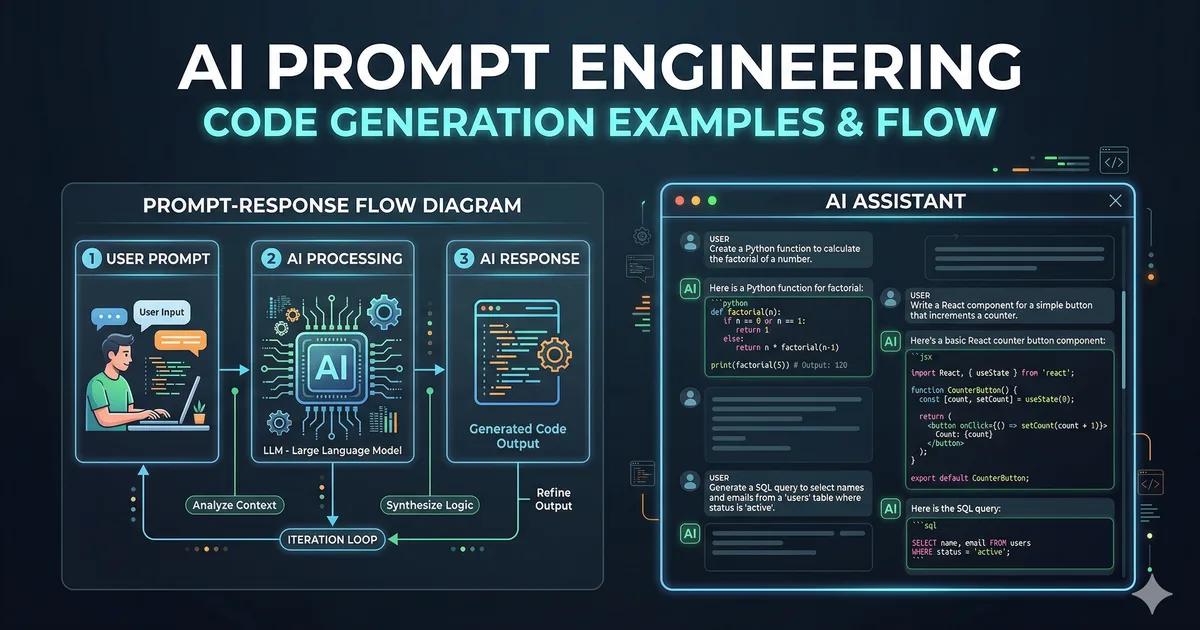

Why does prompting matter for developers?
The difference between a mediocre prompt and an excellent one can be the difference between code that barely works and production-ready code. As developers, we have an advantage: we think in a structured way and can apply that skill to prompting.
This article will teach you specific prompting techniques optimized for programming tasks.
Fundamental principles
1. Be specific with context
Language models cannot read your mind. The more context you provide, the better the result.
Weak prompt:
Create a login form
Strong prompt:
Create an Angular standalone login component with reactive forms. It should have email and password fields with validations (valid email, password minimum 8 characters). Use signals for loading state. Implement OnPush change detection. The form should display inline error messages below each field.
2. Define the constraints
Specifying what you DON'T want is as important as specifying what you do want.
Requirements:
- Strict TypeScript, no 'any'
- No external dependencies
- Compatible with Node.js 20+
- Complete error handling

Constraints:
- DO NOT use classes, only functions
- DO NOT use callbacks, only async/await
- DO NOT use console.log in production
3. Provide examples (Few-shot)
Showing the pattern you expect is more effective than describing the pattern.
Advanced techniques
Chain of Thought
Ask the model to reason step by step before generating code:
I need a function that determines if a string is a palindrome.

Before writing the code:
1. Define what a palindrome is
2. Consider edge cases (spaces, uppercase, special characters)
3. Evaluate different approaches and their complexity
4. Choose the best approach

Then implement the function in TypeScript.
This technique is especially useful for algorithmic problems and architecture decisions.
Role prompting
Assigning a specific role to the model significantly improves quality:
Act as a senior software engineer with 10 years of experience
in Angular and TypeScript. Your priority is maintainable code,
with strict types and tests. You prefer composition over inheritance
and pure functions over side effects.
Incremental prompting (Iterative)
For complex tasks, build the solution in steps:
- Step 1: Define the interface/types
- Step 2: Implement the core logic
- Step 3: Add error handling
- Step 4: Add tests
- Step 5: Optimize and refactor
Prompt template for code review
Review the following code considering:

1. **Bugs**: Logic errors or potential runtime errors
2. **Security**: Vulnerabilities (XSS, injection, etc.)
3. **Performance**: Expensive or unnecessary operations
4. **Types**: Correct use of the TypeScript type system
5. **Readability**: Names, structure, comments

Response format:
- Severity: CRITICAL | HIGH | MEDIUM | LOW
- Affected line(s)
- Problem description
- Suggested fix with code

[Paste your code here]
Prompts for common development tasks
Generate TypeScript interfaces
From this API JSON response:
[paste JSON]

Generate TypeScript interfaces that:
- Use strict types (no any)
- Handle optional fields correctly
- Include JSDoc with a description for each field
- Use descriptive PascalCase names
Refactor legacy code
Refactor this Angular code from the old version to modern:

Requirements:
- Migrate from NgModules to standalone components
- Migrate from constructor injection to inject()
- Migrate from decorators (@Input/@Output) to input()/output()
- Migrate from BehaviorSubject to signals
- Migrate from *ngIf/*ngFor to @if/@for

Maintain the same functionality. Explain each change.

[Paste code]
Write documentation
Generate technical documentation for this function/class:

Include:
1. General description (1-2 sentences)
2. Parameters with types and description
3. Return value
4. Basic usage example
5. Example with edge cases
6. Possible throws/errors

Format: TSDoc compatible

[Paste code]
Anti-patterns: what NOT to do
1. Vague prompts
Avoid: "Make a CRUD". It doesn't specify the technology, structure, validations, or error handling.
2. Asking for everything at once
A prompt with 50 requirements will produce mediocre results. Break it into steps.
3. Not validating the output
Always review and test generated code. Models can generate code that looks correct but has subtle bugs.
4. Copying without understanding
If you don't understand the generated code, don't use it. Ask for explanations.
Building a system prompt for your team
A well-designed system prompt can standardize the quality of generated code for your entire team.
Key elements
- Tech stack: Specific versions of frameworks and libraries
- Code conventions: Naming, file structure, patterns
- Constraints: What should NOT be used
- Response format: Expected output structure
Conclusion
Effective prompting for programmers comes down to three things: clear context, explicit constraints, and concrete examples. Invest time in building good prompts and reusable templates for your team.
AI is only as good as the instructions you give it. A developer who masters prompting multiplies their productivity significantly.
Comments (0)
Sign in to comment